How Agentic AI Is Changing Enterprise Workflows in 2025
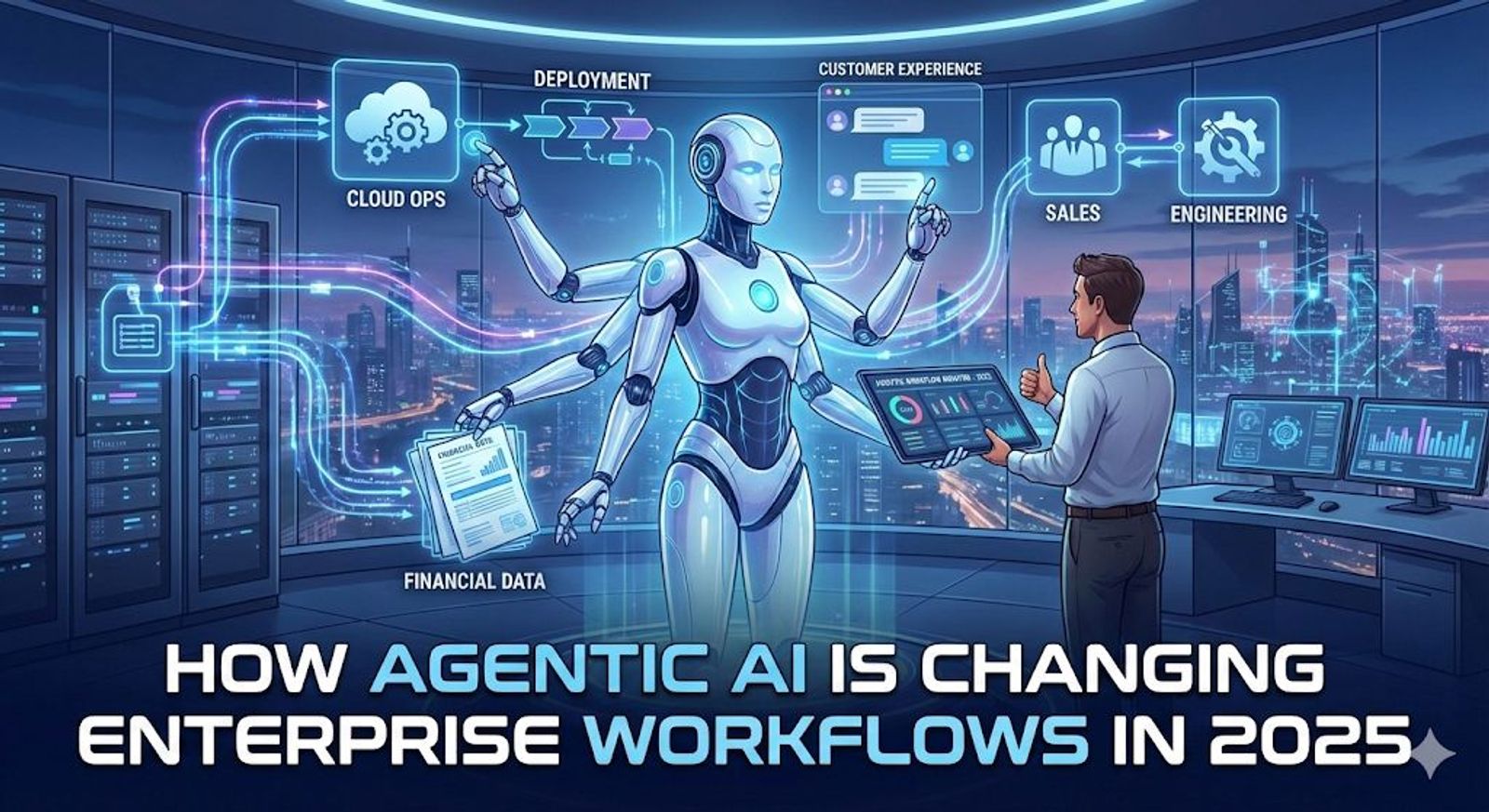
A quick look at how agentic AI is transforming enterprise workflows in 2025, from automating complex cloud operations to streamlining cross-team tasks, boosting customer experience and redefining how humans collaborate with AI. Learn why these autonomous systems are becoming essential for modern businesses.
Contents
If you've been paying attention to enterprise tech lately, you've probably noticed something interesting happening. AI isn't just answering questions anymore—it's actually doing things. We're talking about agentic AI, and it's quietly reshaping how businesses operate in 2025.
So What's the Big Deal About Agentic AI?#
Think of agentic AI as that colleague who doesn't just tell you what needs to be done, but actually goes ahead and does it. These systems can understand what you're trying to achieve, break it down into steps, juggle multiple tools at once, and see tasks through to completion. The best part? They need way less hand-holding than traditional automation.
I've seen companies completely transform their operations with this technology. Instead of having teams bounce between five different systems to complete a single workflow, an AI agent handles the coordination and just reports back when it's done. It's pretty remarkable when you see it in action.
The Real-World Impact on Cloud Operations#
AWS really kicked things into high gear when they rolled out their agentic infrastructure tools. I remember talking to a DevOps engineer friend who used to spend his evenings babysitting deployment pipelines and chasing down mysterious alerts. Now? An AI agent monitors everything, spots issues before they become problems, and fixes them automatically.
These agents are handling the grunt work-provisioning environments, running tests, even rolling back updates when something looks off. The result is systems that stay up longer and run more smoothly. And engineers finally get to focus on actual engineering instead of firefighting.
Where Traditional Automation Falls Short#
Here's the thing about old-school automation: it needs explicit rules for everything. "If this happens, do that." But what about all those messy, semi-structured tasks that don't fit neatly into if-then statements? That's where agentic AI shines.
Right now, companies are using these agents for tasks that used to require human judgment:
- Reviewing documents that come in different formats from different departments
- Pulling together financial summaries from scattered data sources
- Figuring out which team should handle an incoming request
- Generating those dreaded compliance reports that nobody wants to do manually
- Evaluating vendors based on dozens of criteria
The agents become bridges between departments, cutting through the usual communication chaos and data silos that slow everything down.
Customer Experience Gets an Upgrade#
This is where things get interesting for end users. Agentic AI can manage entire customer journeys, from that first exploratory email to post-purchase support to renewal conversations. It's plugged into your CRM, knows your history, and can make decisions about next steps without waiting for someone to manually update a spreadsheet.
I've noticed businesses using this technology tend to resolve issues faster and maintain more consistent service quality. As a customer, you're interacting with systems that feel more responsive and, dare I say, more human in their ability to connect the dots.
But We Need to Talk About Guardrails#
Here's something that keeps enterprise leaders up at night: when you give AI systems the ability to take action, you need to make absolutely sure they're not going to do something catastrophic. We're seeing a lot of investment in governance frameworks right now audit trails, permission systems, sandbox environments where agents can be tested safely.
Every action an agent takes needs to be traceable and reversible. Companies are learning this the hard way, and the smart ones are building these controls in from day one rather than bolting them on later.
What This Means for the People Behind the Tech#
The relationship between humans and AI is evolving. Instead of treating AI as just another tool in the background, employees are learning to collaborate with agents. You guide them, check their work, and step in when judgment calls are needed. The AI handles the repetitive, cross-system coordination stuff that used to eat up hours of your day.
This frees people up to do the work that actually requires creativity, strategic thinking, and human intuition. I've talked to teams that have adopted this approach, and they consistently report faster turnaround times and way less operational stress.
The Bottom Line#
Agentic AI isn't some distant future concept, it's happening right now in 2025, and the companies embracing it early are seeing real benefits. The workflows are smoother, the overhead is lower, and teams are more efficient across the board.
Of course, like any powerful technology, it needs to be implemented thoughtfully. But if you're still relying on purely manual processes or rigid rule-based automation, you might want to start exploring what's possible with agentic systems. The gap between early adopters and everyone else is only going to widen from here.
What's your experience with AI agents in your workflow? Are you already using them, or still figuring out where they'd fit? Let me know in the comments.

Dhiwahar Adhithya Kennady
I am a Data Science graduate student at New York University with a strong foundation in machine learning, deep learning, and AI systems development. I enjoy solving real-world problems through data, and I have completed several hands-on projects and internships across research labs, startups, and industry settings. I have experience building end-to-end AI pipelines, developing production-ready machine learning systems, and working with modern tools such as PyTorch, TensorFlow, Docker, FastAPI, and cloud platforms. My work spans medical imaging, speech-based AI, customer analytics, and NLP applications. I have built large-scale data pipelines, designed high-performing classification models, deployed containerized AI services, and contributed to impactful research in deep learning for healthcare. I am passionate about learning new skills, exploring advanced technologies, and taking on challenges that push my technical boundaries.